I’m so excited to share my interview with Linda Lewis. She is an early childhood education leader, business woman, longtime partner to her spouse of 26 years, mother of her two wonderful grown children, and truly a visionary. Although she’s accomplished and strong, she’ll bring brevity and laughter to an intense meeting, and shares the most delicious dish at a potluck.
A couple of her super powers include making everyday things beautiful and putting the people in her company at ease, she’s a natural teacher. Recently a neighbor’s tree branch fell in her yard. She explained, “A perfect Sycamore branch fell and now I have it on a pulley system in the ECP (Early Childhood Program at Harmony School), so I can hang artwork.” And if your child was/is in her childcare program, you know she has a knack for making your children feel like they can do just about anything.
Linda has a daughter my son’s age, they were in this same class for most of elementary and middle-school. She was my youngest child’s preschool teacher. And we worked together on various committees and boards at the school during that time. The thing that strikes me most about her is her intentional living style, bringing joy and beauty to what she chooses to do, including how she parents.
On starting a preschool:
In 1993, Linda saw an opportunity to bring her Montessori background to Harmony School and established the ECP. The program hosts 3-5 year-olds and transitioned from a predominantly Montessori philosophy to a play based philosophy over the years as Linda’s philosophy changed. The experience of the ECP is really special. Children in this childcare setting are truly allowed to play in uninterrupted blocks of time, climb, create art, and run inside and out in bare feet. There’s a natural and comfortable feel, almost an extension of home, unique to a quality childcare setting.
On taking an adventure:
After several years of leading the program, Linda took a year’s absence from work to teach English in São Paulo, Brazil where she lived with her friend, Karla. She worked with executives from global companies, such as Merck and Hertz. They were advanced English speakers, so her job was to have conversations with them, so they could practice their English. “It was my job to talk to people, many of them were interesting people.”
During Christmas time she traveled home to Brown County in south central Indiana, and returned with her niece to explore more of Brazil. They visited Salvador, a city she became drawn to because of its historic district with cobblestone streets, beautiful old buildings, and rich cultural heritage. She didn’t know this would be the city where she would later meet her husband, Iuri Santos.
She returned to São Paulo and her niece went home, but the English classes were on pause because it was nearing Carnaval time, which marks the beginning of Lent with parades and music. During that time, many people aren’t working. “I wasn’t learning Portuguese because I was only speaking English, so I decided to go back to Salvador.” She returned by bus and found a short-term apartment there. “I was having fun, I’ve never been fearful. But I could barely speak Portuguese. I had candles and went to buy matches, but I didn’t know how to say matches, so it took forever to try to figure out how to tell people what I was trying to buy.”
While she was there, she decided she wanted to study Capoeira Angola , an art that incorporates dance, music, martial arts, musical instruments and ritual. She’d been practicing Capoeira Regional in São Paulo, a newer form of capoeira; a pop version of its original form that incorporates a belt system and acrobatics. She found a class and told the mestre that she wanted to study Angola there and Regional at another school to which he replied, “No you’re not. You can’t study here and there, it’s going to be one or the other (in Portuguese).”
Linda decided to take the class and met Iuri who was a contra mestre there. She wanted to learn how to play the berimbau, so she asked if anyone wanted to trade English classes for berimbau lessons. Iuri volunteered. She tried to call his home, but could never set-up the lesson, because she couldn’t explain to his mother why she was calling, she didn’t speak Portuguese.
It was time for Carnaval. During this time parades feature street bands called blocos, which mobilize the crowds. One can purchase a ticket for the group you want to be part of (picture traveling and dancing throughout the streets with your band). The parade in Salvador featured a bloco from her capoeira class, in which Iuri was the main singer.
The event starts during the day and lasts late into the night. Because you’re traveling with your group from one side of town to the other, you have to get back to your starting point. Iuri helped Linda find her way back home after the parade.
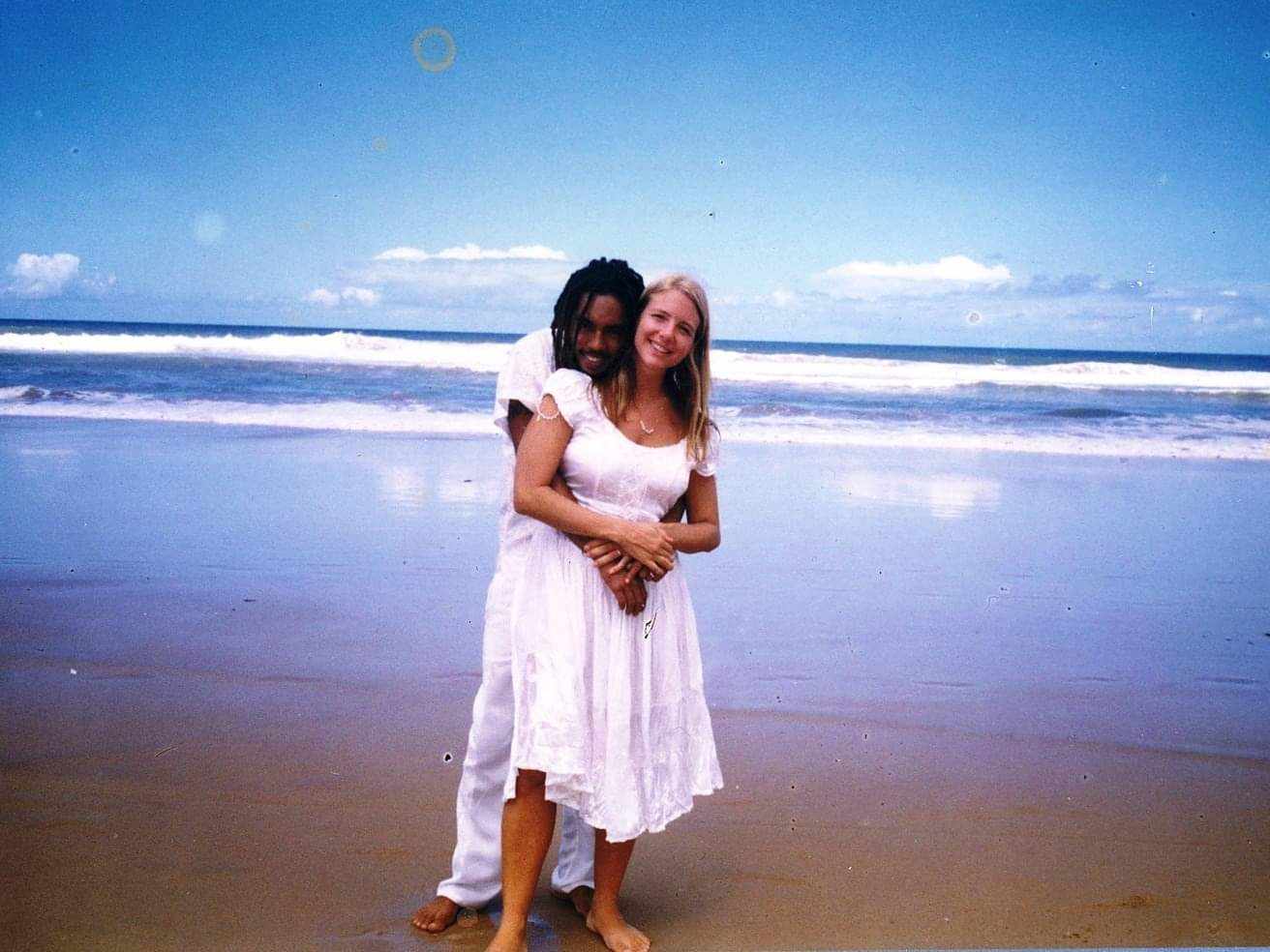
Linda’s job in São Paulo was waiting for her, and her lease in Salvador was coming to an end. Iuri encouraged her to keep her things at his mom’s and visit Chapada Diamantina with him, a park in the interior of Brazil. They hiked for several days. Linda shared, “That’s where we decided to get married. I was going to go back home, but we couldn’t go back together unless we got married.” They married one month after meeting at a huge courthouse with three judges who were marrying several couples at one time.
On returning to the U.S. and starting a family:
Moving back to the United States was a smooth transition. “I already had my own house and job. We already knew other blended American/Brazilian couples. I think our marriage worked well because we had similar lifestyles and are open minded.” Iuri immediately started teaching Capoeira Angola. He’s also an amazing musician and has led several Reggae bands in Bloomington over the years.
“Two years later, we were going to have a wedding, but decided to spend the money on a trip back to Brazil.” Shortly after that trip they learned they were pregnant with their son. “We didn’t have huge cultural differences because Iuri’s parents were tropicalistas. They were into natural food and super open minded. They are awesome.”
In addition to Iuri, Linda’s amazing birth team included his mother, her friend Karla from São Paulo, a dear friend from Bloomington, her sister who was a labor and delivery nurse, her niece, a beloved Bloomington midwife, and a medical doctor. There was a special touch Iuri wanted to add to Linda’s labor and birth. They tied a red ribbon around her stomach as a protective measure, which is a tradition from the Candomblé spiritual practice in Brazil. “I wore it most of the time, and he buried it with the placenta under a tree after the birth.”
Their son was three when Linda and Iuri adopted their daughter. “I had always said I was going to have one kid and adopt one kid. I was 19 or 20 when I decided that. I went to Dunn Meadow for an environmental fair and there was a table hosted by an organization called Zero Population Growth. They said people should have two kids, one to replace each parent. But I knew a lot of people weren’t going to do that so I decided I’ll just have one and adopt another one and that’s what I did.”
On adopting her youngest:
When the couple was ready to start the adoption process, they attended a welcome and information night for interested parents. Because Iuri is black and Linda is white, they wanted a black or bi-racial baby. There were three different types of adoption, 1.) International, 2.) domestic for a white baby, 3.) domestic adoption for black, bi-racial, hispanic, and special needs. The third, all one category. Each of the three categories had different prices, and the third category was the least expensive. The agency explained this from what they considered a practical approach or a supply and demand issue. To Linda and Iuri, it felt shocking.
At first they were matched with a mother that changed her mind once the baby was born. Two weeks later a baby was born to a mother who had not signed up with the agency. She decided to put the baby up for adoption while she was in labor. The agency called Linda at work to tell her the baby was born. She was in the hospital 48 hours before they would release her. Linda was nursing her toddler at the time and wanted to have milk for the baby. “There’s a difference between the milk for a toddler and newborn. I needed to pump a lot to get ready, so the milk was more compatible for a newborn”. We got to hang out with her and nurse her before they released her.”
Her daughter’s adoption was a semi-open adoption, meaning the birth mother knew who Linda and Iuri were, but the couple didn’t know who she was. Linda emailed pictures of her daughter to her birth mother while she was growing. They made a plan to meet on MLK Day several years ago, but because of various circumstances they never did.
“We were going to meet them (birth mom and her family) at their church which was holding a celebration to honor Dr. King in Indy. The day before her birth mom stopped replying to messages. Our whole (immediate) family went to Indy assuming the meeting was still going to happen. There were only maybe 30 people there, although it was a really huge church building”
There was a welcome by the preacher, inviting the congregation to testify. A response was made by almost every congregation member. One gentleman said, “I am really thankful I was able to get out of jail after 30 years.” One woman shared, “I’m really thankful my son who got shot is going to make it.” Another stated, “I pray for my son to get out of jail.” There were at least three other people who spoke about one of their friends or family members getting shot. These were all people who lived downtown in Indianapolis.
“Then it was our turn. Iuri starts with a Rasta prayer and I’m thinking ‘this is a Christian church, they’re (congregation) not going to like this’. Then he stops and says, ‘Thank you for having us here. We’re here because my daughter was adopted and her birth mom is supposed to be here, but we don’t see her, she must not be here today, but we are glad to be here today’. I’m thinking maybe the birth mom didn’t want everyone to know she put a baby up for adoption, or maybe they already knew it. I’m just thinking all of these things.” To Linda’s surprise, when he finished they received the warmest response. The congregation stood and clapped and welcomed the family.

On having a multiracial family in south central Indiana:
There have definitely been some challenges for a multiracial family living in south central Indiana, especially for Iuri. “He’s had a feeling people are looking at him, sometimes they’re not looking at him with malice, but they’ve never seen men that look like him before. And sometimes they are looking at him with disdain. It’s hard to tell what people are thinking.”
She also felt some differences in how guarded she felt with her children when they were younger. Because her son looks white, most wouldn’t assume he was bi-racial. She felt more guarded with her daughter because she looks different, she is black. “We live in a culture that celebrates whiteness. I think it’s getting better and more people are trying to bring awareness to it and I try to bring awareness to it for her. Her dad is really good about talking about how black is beautiful and black history, talking about contributions black people have made throughout history. But she’s a kid growing up in this culture in the United States.”
On teaching at your kid’s school while simultaneously starting a new business:
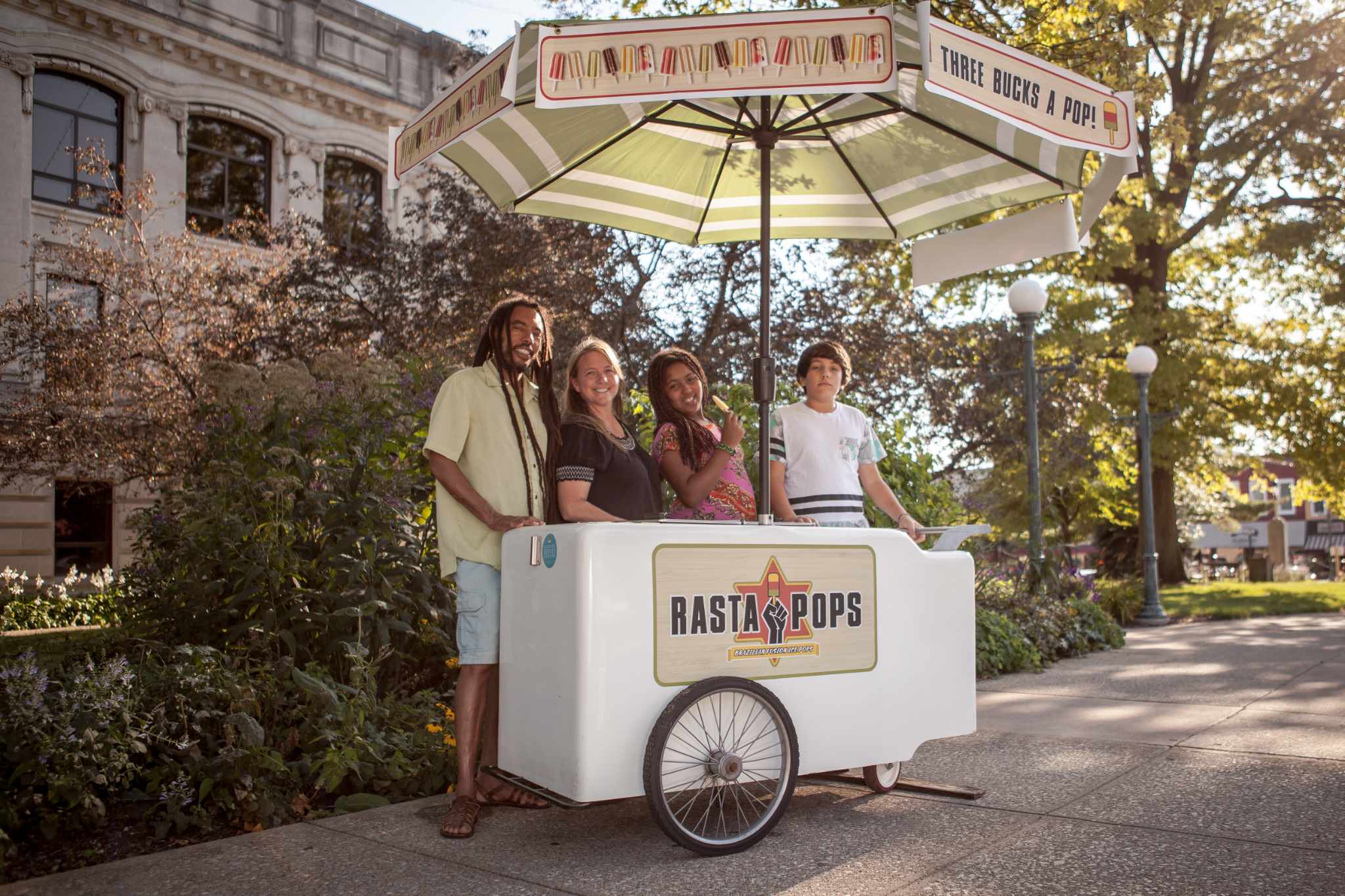
“Mostly it was great. They both had really good school experiences.” In 2015 Linda and Iuri decided to start Rasta Pops, what is now a popular artisan ice pop business. Iuri was teaching capoeira and driving a taxi. In summer time the taxi driving was slow, so he was looking for a summer job. “We were taking a walk through Bryan Park, and he said they need an ice pop seller here. In Brazil it’s really common, just like the ice-cream man in the U.S. That’s one of the best memories our kids have in Brazil. In Brazil they just carry a cooler with a strap on it around their neck. Here you have to have a cart and be able to keep the temperature. You have to have a certified kitchen. We were able to start with a very small investment.”
“At first it was really hard because on top of working at Harmony full-time, I had to help Iuri in the kitchen and get the business side established. It was a big learning curve. It felt like it was two full-time jobs, especially the last month of school (May) and the first month of school (August). And the kids were younger. Now we can hire people to help in the kitchen and to sell pops. It’s doing really well. We get catering events with IU and Food Truck Friday is great now. We do the occasional festival.” Last year they were vendors at Farm Aid in Noblesville, Indiana and Granfalloon, where The Flaming Lips performed free for Bloomington, Indiana. They also participate in Bloomington Pride each year.
The couple’s other business venture is their vacation rental, Aspen Lake House in Brown County. “We were able to rent our old house. We didn’t want to let it go, but didn’t want the commute (to Bloomington) each day. It stays really well rented I think because of the lake.” The house is beautiful and the property is a great venue with room to hike, canoe, and enjoy the view from the deck, complete with a hot tub.
On relationships with adult children:
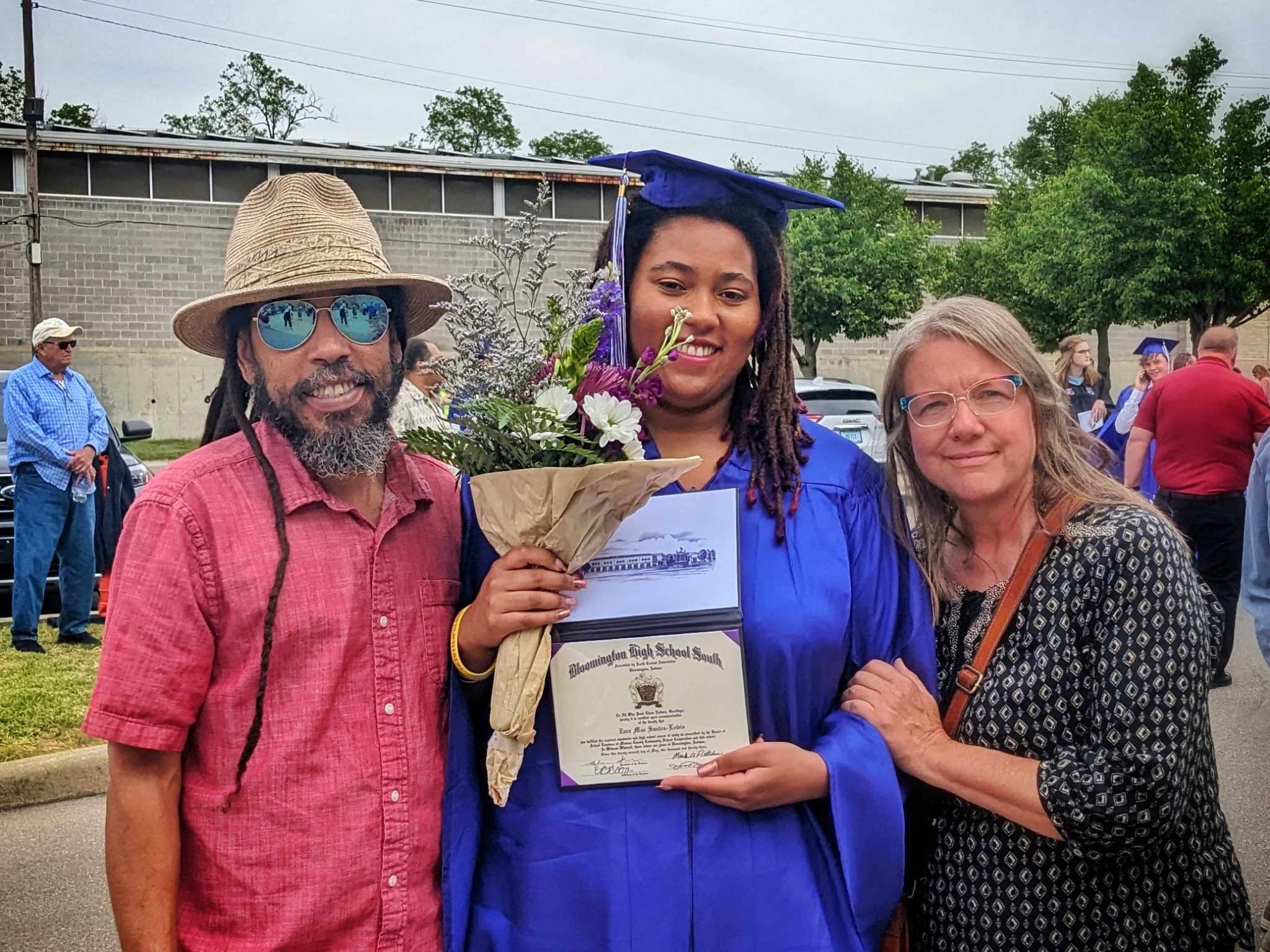
“Geographically we are close to downtown, so our house was always where kids would hang out. I liked that because I like to know who my kids are hanging out with. And I’m pretty hands off. I try to trust them. And now that they’re both over 18 I’m definitely more hands off. My daughter is outgoing and happy and has a lot of friends. She works at IU, providing food service. She still has sleepovers Friday and Saturday, she’s super social.” She’s also adopted her parent’s entrepreneurial spirit. In highschool, she started her own dog walking business.
Her son is a teacher in the ECP and also plays and studies capoeira. “He fishes, he has a smart, sweet girlfriend. He is enjoying himself right now. Eventually he may want something different. He’s enjoying his life and is making an impact in what he’s doing. From the moment I arrive at school, the kids ask ‘when is he going to be here?’ and ‘what time is he coming?’ They can’t wait to see him. In Brazil, kids typically live at home until they get married. I don’t know what he will choose to do, but I think it will be awesome. I don’t want to push him to study something he’s not interested in. It has to come from him.”
Thank you for sharing with us, Linda!
 Wonderfully Woven